
劳动力研究报告:支持那些支持我们孩子的教育工作者
At Denver Preschool Program (DPP), we believe early childhood educators are at the heart of every child’s learning…

At Denver Preschool Program (DPP), we believe early childhood educators are at the heart of every child’s learning and development. We aim to support the dedicated teachers who are shaping the minds and futures for our littlest learners. To do that, we must first understand what they truly need to succeed, both inside and outside the classroom.
Recently, we conducted extensive workforce research on early childhood educators across Denver. Research and interviews with educators and community leaders led us to uncover deeper insights about the early childhood workforce, including career paths, working conditions and overall provider well-being. Additionally, we explored salary tiers, satisfaction with compensation, financial stability and professional development, all with the goal of improving experiences for educators and children alike. Here’s what we found.
Educator Insights: A Passion for the Work
One of the clearest findings from the research was the deep commitment educators feel toward children and families. Many educators shared that they entered the field because of a lifelong love of working with children, personal experiences with caregiving or a desire to create more inclusive and equitable learning environments.
- Educators tend to stay in the field for an average of 7 years. Half of the educators surveyed had worked in the field for 10 years or more. More than half (64%) view their current position as their chosen occupation and most are satisfied with their career choice.
- Interview findings also showed high levels of satisfaction with coworker relationships, workplace culture and opportunities for professional development.
For families, this love for teaching and caregiving shows up in everyday moments – like when kids run in for one last hug at pickup or rush through the door at drop-off to show their teacher something they made or are proud to wear. The love for the work is visible, and, at the same time, parents often wonder how providers do it, day after day, with full classrooms and a range of big emotions in little bodies. There is certainly no question that being an educator is hard work.
Diversity in Early Learning
Denver’s early childhood workforce is remarkably diverse, with a significant population being racially, ethnically and linguistically diverse (RELD).
- 38% surveyed identified as Hispanic, Latino or Spanish Origin (HLSO)
- 38% identified as White or European American
- 10% identified as two or more races/ethnicities
- 7% identified as African, African American or Black
Nearly half of educators (48%) are linguistically diverse, with Spanish-speaking providers making up 77%. This diversity is a major benefit as it fosters connection between educators, children and families across multiple languages.
This representation matters deeply for children and families. Children benefit from seeing educators who reflect their cultures, languages and lived experiences – and who mirror the communities they are a part of.
The Complexity of the Modern Classroom
Our research highlighted a well-documented trend across education and beyond: the evolving emotional and behavioral needs of young children in today’s world.
- Educators reported more children are entering preschool with trauma-related behaviors and less ability to self-regulate, requiring more extensive teacher support and wraparound services. As a result, many providers surveyed reported experiencing burnout.
On the other hand, strong partnerships between families and educators can make a meaningful difference. Consistent routines, open communication between families and providers and shared approaches to fostering emotional support help children feel more secure and connected. When children feel safe and regulated in their environments, educators are better able to focus on teaching and caregiving without experiencing high levels of stress.
The Need for a Living Wage
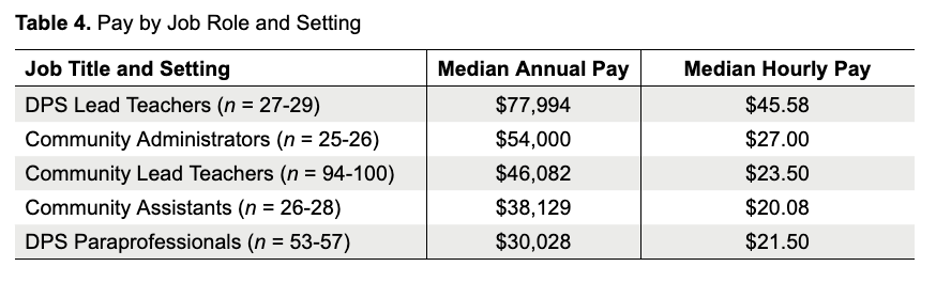
Not surprisingly, the research also revealed significant challenges related to compensation and affordability. Many educators reported low wages, high healthcare costs and ongoing financial stress. Some shared that they work additional jobs or rely on public assistance to meet basic expenses.
- 28% of surveyed educators reported utilizing at least one form of public assistance.
- Among educators receiving public assistance, the most common benefits received were Medicaid or Medicare coverage (62%), Medicaid or subsidized health insurance for their children (34%), free or reduced lunches for their children (30%) and food stamps (SNAP; 25%).
These challenges affect the sustainability of the early childhood workforce and contribute to burnout and turnover across the field. Here is a glimpse at the pay scales for Denver educators:
Success of DPP Programs
Educators expressed deep appreciation for programs and supports that help make quality preschool more accessible for families and more sustainable for providers.
- One director described DPP as “the magic wand of the community” and “a lifesaver.” Others view DPP as an exceptional partner due to our flexibility and responsiveness.
- The study results showed that DPP tuition credits are essential. Many providers cited that most of their students would not be there without tuition credits.
- Feedback showed that workforce stipends were appreciated and effective.
- Educators praised DPP professional development events and grants.
What This Means for DPP and Families
High-quality early childhood education depends on strong, supported educators. When teachers have access to fair compensation, professional growth and community support, children benefit too.
Denver Preschool Program has always been committed to supporting educators, through direct stipends and programming, advocacy and leadership. Research like this helps us assess current programming for improvements or adjustments to better meet today’s classroom needs. Learn more about the insights that have inspired program improvements, childcare solutions and more in our 2025年影响报告. And be sure to check out our latest research on our 影响页面.